🔍 RP L1 T3: Factors Contributing to Relapse
📚 Please refer to the Materials section for additional learning resources and further reading. You may download these materials for future reference.
Before we go in-depth, let us try to recall a few facts on “determinants” of relapse discussed in Lesson 1, Topic 1
[elc_h5p id=”19″]
In this topic, we will understand the factors contributing to Relapse. The predominant focus is one Cognitive Behavioural model for relapse.
Factors contributing to relapse encompass a complex interplay of personal, environmental, and psychological elements that can pose challenges to individuals striving for sustained behavioral change. Recognizing and understanding these factors is pivotal in developing effective strategies for relapse prevention
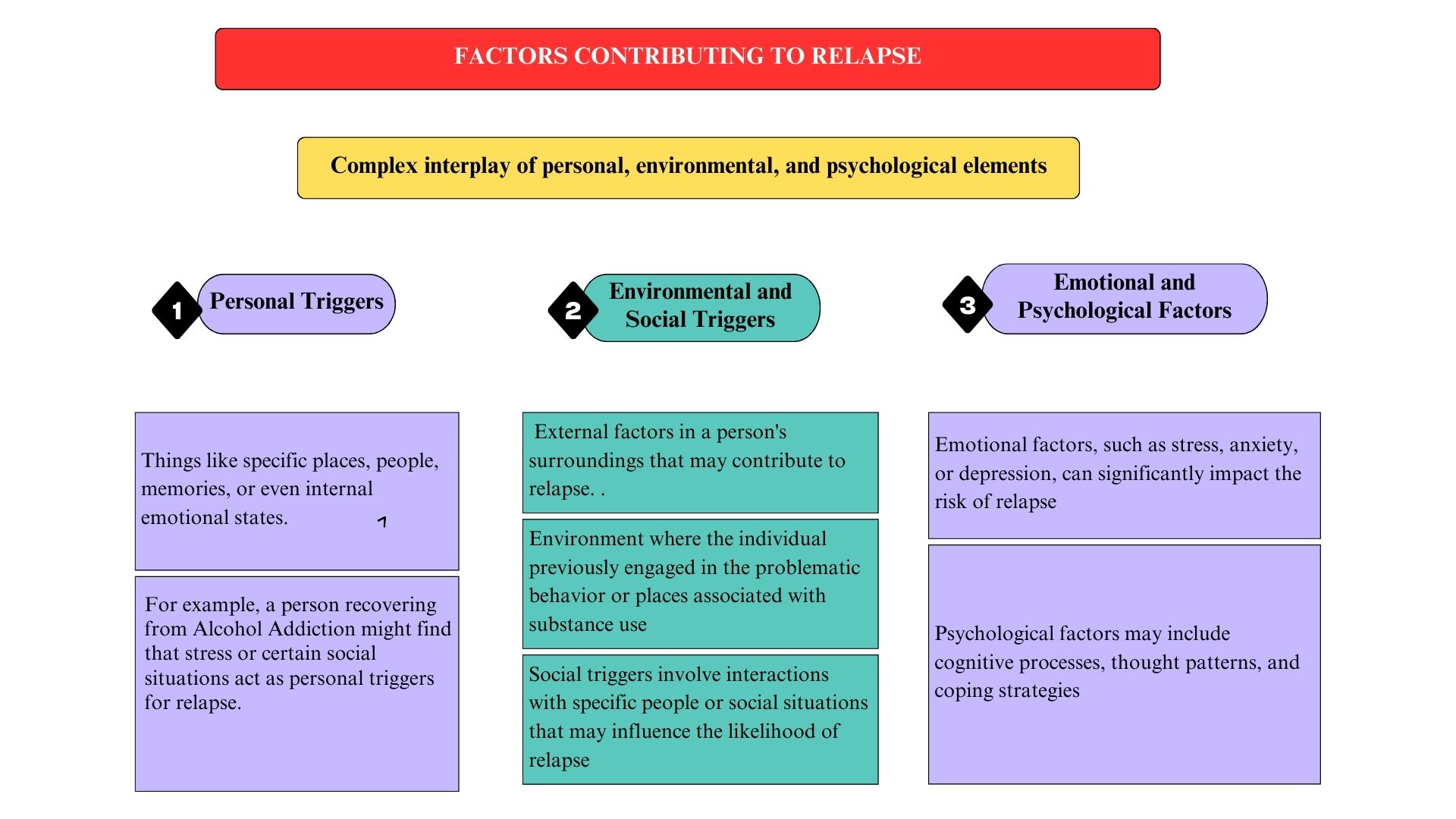
.As per Psychological Theories, two types of expectancies can play a crucial role in relapse
| Outcome Expectancies | An individual’s beliefs about the effects of a drug if it is used in a given situation |
| Self-efficacy Expectancies | An individual’s estimation that he or she can successfully enact a behavior in a given situation |
Relapse process
Marlatt and his colleagues have provided the most discussed and clinically applied model of the relapse process. It was originally
summarized by Marlatt and Gordon (1985) and subsequently updated and revised in important ways by Witkiewitz and Marlatt (2004).
A central aspect of the Marlatt model (1985) is the detailed classification (i.e., taxonomy) of factors which can fall into two categories: immediate determinants (e.g., high-risk situations ⬇️, a person’s coping skills, outcome expectancies, and the abstinence violation effect) and covert antecedents (e.g., lifestyle imbalances and urges and cravings).
High risk situations:
Immediate Determinants of Relapse
Marlatt and Gordon 1985

- Initiation of Abstinence: Marlatt hypothesized that starting abstinence boosts a sense of personal control and self-efficacy.
- Strengthening Self-Perceptions: These self-perceptions grow stronger as the period of abstinence extends.
- Encounter with High-Risk Situations: Over time, the individual is likely to face situations that increase the risk of relapsing into substance use.
- Central Feature of the Marlatt Model: High-risk situations are a key component of the Marlatt model of relapse.
- Antecedents of High-Risk Situations: These can vary but often involve cognitive and lifestyle factors that lead to high-risk circumstances.
- Coping and Behavioral Repertoire: If the person has effective coping strategies in their behavioral repertoire and uses them, it leads to a successful outcome.
- Enhancing Self-Efficacy: Successful coping reinforces self-efficacy (as per Bandura, 1977), which in turn reduces the likelihood of relapse in similar future situations.
On the other hand, if the person is unable to emit an effective coping response, then this will lead to a decreased level of self-efficacy and an increase in the attractiveness of the substance as a mechanism for dealing with the situation. This is particularly the case if the person
Witkiewitz KA, Marlatt GA, editors. Therapist’s guide to evidence-based relapse prevention. Elsevier; 2011 Apr 28.
maintains positive outcome expectancies regarding drug effects. As the attractiveness of the substance increases (in conjunction with decreased self-efficacy), it becomes more likely that the person will use the drug in that situation.
Revised Conceptualization of Relapse process
In the previous topic, you came across two categories of situations where the relapse process can be initiated, i.e. Immediate determinants and Covert antecedents.
On the basis of new research relevant to the components of the original relapse prevention model, Witkiewitz and Marlatt (2004) provided a revised conceptualization of the relapse process. The new model i.e. Central Determinants of Relapse and Distal Risk factor for Relapse is below (Witkiewitz & Marlatt, 2007)
| Central Determinants of Relapse | Distal Risk factor for Relapse |
| Negative emotional states Positive emotional states Lesser levels of coping Greater outcome expectancies regarding substance use Lower self-efficacy Abstinence-violation effect (AVE) Greater craving Interpersonal relapse precipitants | Family history of substance abuse, Lesser extent of social support Severity of dependence |
We read every comment personally — your feedback helps us refine and improve the content with every update. Thank you for being part of this journey.
📝 Tip: Make use of the Notes section at the bottom of each lesson to save key points—it will make revision much easier before taking the quiz.
🔒 If “Mark Complete” is not visible, complete the practice activity above and score above 50% to unlock it and proceed to the next; you may retry as many times as needed.
Supplementary reading on Coping with Lapses