
Alert
(Visible only for enrolled users)
Completing this primer requires dedicated time, undivided attention, and concentrated reading. These modules assume foundational knowledge in the subject area and build on existing clinical understanding. Please ensure you are prepared and review the information below before enrolment
🔍 Quiz Monitoring Enabled:
The quiz is monitored using ProctoPress 🔐 – Exam Proctoring for LMS. Webcam, microphone, and screen activity are recorded during the attempt.Please plan sufficient time to complete the entire Primer Module. Some quizzes include short essay questions that require additional time to answer and are manually graded by faculty. To avoid delays in receiving your quiz grade near the submission deadline, please complete all quizzes well in advance.
We would encourage you to watch this video to know more about “🍻 Primer on Alcohol Use Disorder”
Module Overview
Alcohol Use Disorder (AUD) is a leading public health burden in India. Nearly 15% of the population (approximately 16 crore persons) consume alcohol, of whom about 5.7 crore experience problem use and 2.9 crore are dependent users in India (National Household Survey 2016 MSJE and AIIMS). Despite this scale, the vast majority of affected individuals never receive evidence-based care — largely because the frontline workforce lacks practical clinical knowledge of AUD screening, identification and providing management and referral.
This Primer on Alcohol Use Disorder (P-AUD) is designed as a concise, focused eLearning resource to build foundational knowledge among healthcare providers on AUD. It serves as both a standalone learning resource and a stepping stone into the live ECHO case-based mentoring model i.e. Certificate Module in Alcohol Use Disorder ECHO.
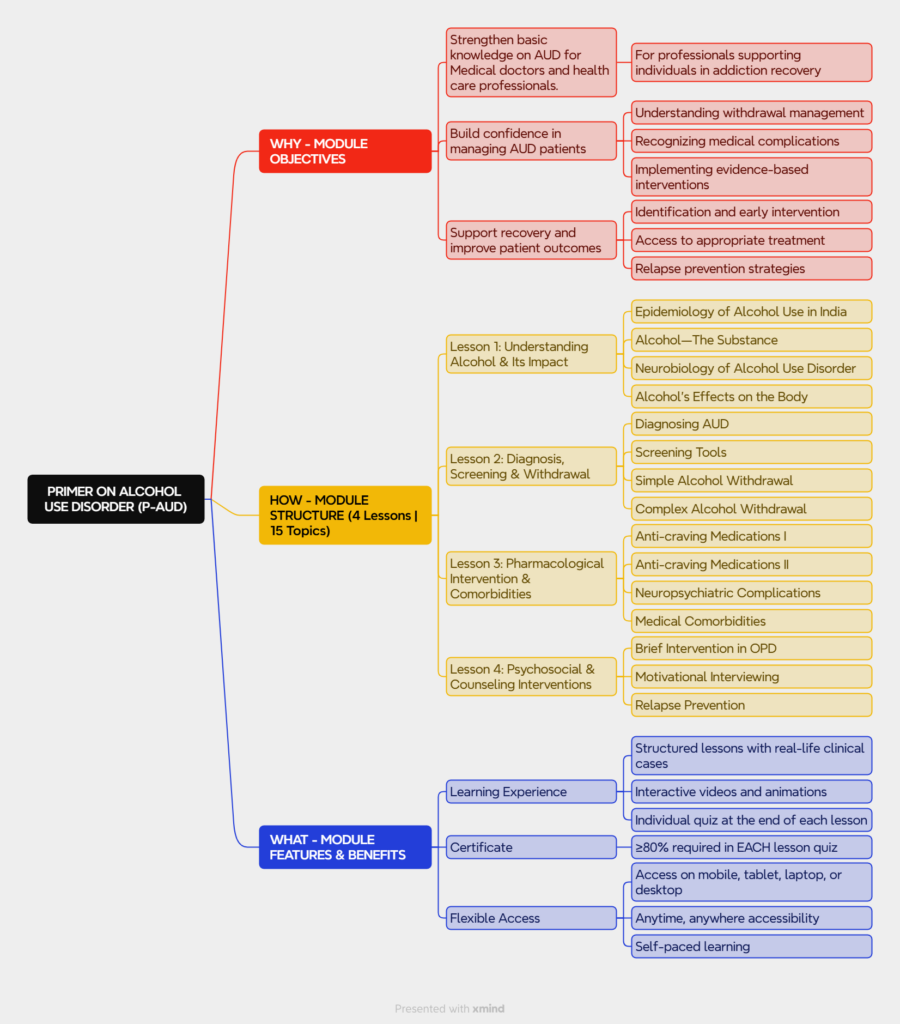
Intended participants
This module is designed for medical doctors — including MBBS practitioners, MD/MS/DNB residents, and specialists in medicine, gastroenterology, hepatology, and psychiatry — who encounter patients with alcohol-related problems in clinical practice but have not had formal training in addiction medicine It is particularly relevant for:
Primary learners
- Medical Officers, Doctors, including specialists (MBBS, MD) in primary, secondary, and tertiary care settings
- Residents of psychiatry, Medicine, gastroenterology, surgery, family medicine, etc who are likely to come across patients with Alcohol use disorders in their practice
- Nurses and CHOs working at Ayushman Arogya Mandir / Health Wellness centres
May be beneficial (secondary learners)
- Practising psychiatrists who want to revise or refresh their knowledge
- Counsellors and Social Workers in clinical settings
- Psychologists working in general health or mental health services
- Health workers in government programmes (DMHP, NCD Clinics, NACO-OST) and NGOs (IRCA, OOTS, ATFs etc)
- Paramedical staff and allied health professionals with patient contact
Pre-requisite Knowledge
- No prior specialisation in psychiatry or addiction medicine is required
- Basic clinical training (MBBS / B.Sc. Nursing / Diploma in Counselling or equivalent)
- Access to a smartphone, tablet, or computer with internet connectivity.
Way forward
It builds practical, evidence-based skills for identification, assessment, and management of Alcohol Use Disorder, and serves as the entry pathway to the CCAUD (Certificate Course in Alcohol Use Disorder) ECHO programme (Link for previous CCAUD course).
Module Goals & Learning Outcomes
Overall Module Goal
To equip medical doctors with foundational knowledge and practical clinical skills for the identification, assessment, and management of Alcohol Use Disorder in diverse healthcare settings.
Learning Outcomes
On successful completion of this Module, learners will be able to:
- Describe the epidemiology of alcohol use in India and its public health significance
- Explain the physiology of alcohol and its effects on major organ systems
- Identify the neurobiological basis of alcohol addiction (alcohol use to addiction) using the reward pathway model
- Classify alcohol use disorders using ICD-11 and DSM-5 criteria
- Implement effective screening (AUDIT) and assessment/evaluation techniques for Alcohol Use Disorder in clinical practice.
- Recognise and differentiate simple from complicated alcohol withdrawal and initiate appropriate management
- Describe evidence-based long term pharmacological interventions for AUD
- Explain principles of Brief Intervention and Motivational Interviewing for use in busy OPD settings
- Outline a practical Relapse Prevention plan for patients with AUD
- Determine when and how to refer patients to specialist addiction services
Instructional Design
Please read the following notes carefully to keep your dedicated time before enrolling to this module
| Certificate Module | Primer on Alcohol Use Disorder (AUD) |
| Learning Level | Medical doctors (MBBS) and above will derive the greatest benefit. No prior specialisation in psychiatry or addiction medicine is required. |
| Learning Modality | Self-paced online asynchronous learning via the NIMHANS e-Learning platform. One needs to complete each lesson and topic and successfully pass the quiz (>80%) to go to the next lesson. Estimated engagement: 2–3 hours per lesson, across 4 lessons. Access duration is 30 days from the date of enrollment. |
| Module Structure | 4 Lessons | 15 Topics | 4 Quizzes with short essay* | 1 Pre-module Survey | 1 Post-module Feedback Lesson 1: Understanding Alcohol & Its Impact (4 Topics ) Lesson 2: Diagnosis, Screening & Withdrawal (4 Topics ) Lesson 3: Pharmacological Management & Comorbidities (4 Topics ) Lesson 4 : Psychosocial Counselling & Interventions (3 Topics ) *The short essay will be manually evaluated and hence needs 48 hours for the clinician to do. Hence it is prudent to start the module early as the access is limited to 30 days |
| Pedagogical Approach | Evidence and Awareness – Introduces key concepts related to Alcohol Use Disorder (AUD), supported by brief research insights and case examples. Reflection – Encourages self-reflection through short exercises and scenarios to build understanding, reduce stigma, and increase awareness in working with individuals experiencing alcohol-related problems. Practice – Focuses on simple, practical skills such as screening, assessment, brief intervention, motivational interviewing, relapse prevention, and the management of alcohol-related problems in community and healthcare settings. |
| Design | Developed by the Centre for Addiction Medicine (CAM) and the Virtual Knowledge Network (VKN), NIMHANS, Bengaluru, |
| Duration of Access | 30 days from the date of enrolment. |
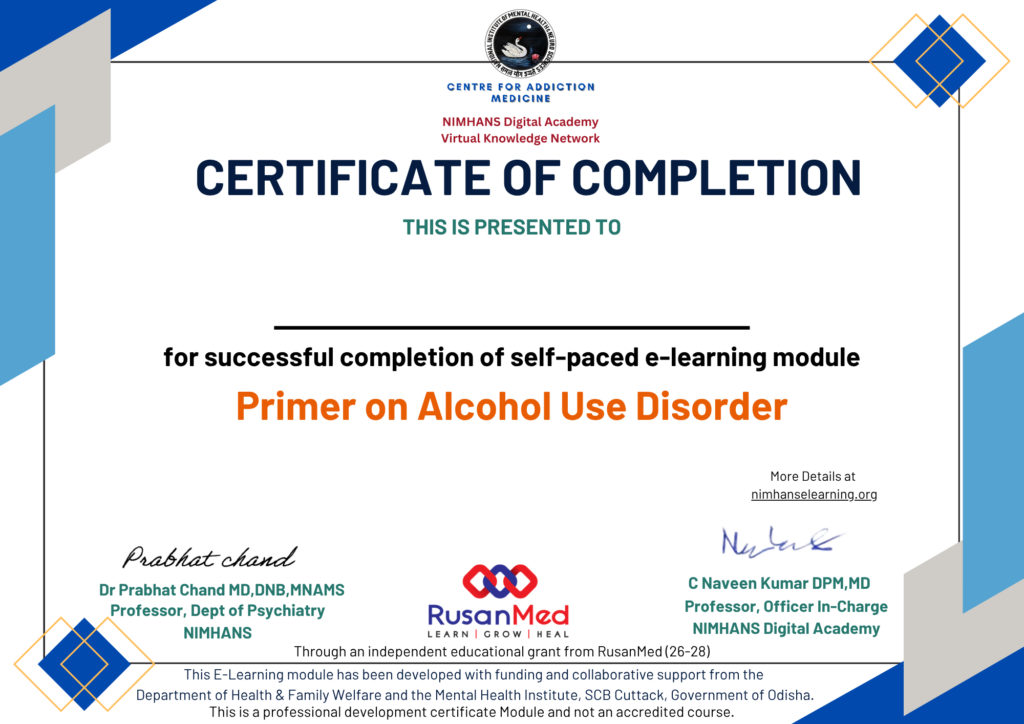
| Professional Development Certificate | Upon completion of all lesson quizzes with a score of ≥80%, participants can download an e-Certificate of Achievement displaying their score. Three attempts are allowed for each quiz. Quizzes assess applied understanding through scenario-based and reflective questions, rather than rote recall. |
| Suggested Citation | NIMHANS eLearning, Centre for Addiction Medicine & Virtual Knowledge Network, NIMHANS, Bengaluru, India. 🍻 Primer on Alcohol Use Disorder Available from: https://addictioncare.in/courses/primer-on-alcohol-use-disorder/ |
| Copyright Information | This license requires that reusers give credit to the creator. It allows reusers to copy and distribute the material in any medium or format in unadopted form only, for non-commercial purpose only. https://addictioncare.in/courses/primer-on-alcohol-use-disorder/ © 2024 by Virtual Knowledge Network, Centre for Addiction Medicine & NIMHANS Digital Academy is licensed under CC BY-NC-SA 4.0     |
| First Edition | June 2026 |
| Funding and Support | A collaboration between NIMHANS and Mental Health Institute, Odisha Digital Academy for Mental Health, SCB Medical College Cuttack, Dept of Health and Family Welfare, Govt of Odisha, |
| Connect with us | vkn@vknnimhans.in It will take 48 hours to respond to the relevant queries related to technical issues. |
| FAQS | 1. Is this an accredited course? This is a professional development certification module from the Centre for Addiction Medicine & NIMHANS Digital Academy and is NOT a formally accredited academic course. This e-learning module is recognised as a professional development module by the NIMHANS Board of Studies, 15th and 17th from CAM. 2. How do I get the Certificate of Completion? Complete all lesson quizzes with a score of ≥80%. Three attempts are available for each quiz. Download the e-Certificate of Achievement after successfully completing all requirements. 3. Do I need to complete lessons in order? Yes, you need to complete each topics in lesson and clear its quiz to move on to the next lesson. |
| Team (Content developer, Designer, Faculty, Technical support) | Centre for Addiction Medicine, Virtual Knowledge Network and NIMHANS Digital Academy National Institute of Mental Health and Neurosciences (NIMHANS), Bangalore, India KNOW OUR TEAM Content lead: Dr Prabhat Chand MD, DNB Professor & Head, CAM, NIMHANS |
Generative AI tools were used in the preparation of this content. All materials have been reviewed and validated by subject matter experts before inclusion.
Certificate for Complete Module
acknowledgement
The development of this Primer on Alcohol Use Disorder has been supported by an educational grant from RusanMed (an initiative of Rusan Pharma Ltd., Mumbai) 2026-28. This grant is provided solely for educational purposes, with no influence on content, curriculum, or clinical recommendations. NIMHANS retains full academic and editorial independence. The Centre for Addiction Medicine, NIMHANS, gratefully acknowledges this support in advancing capacity building among healthcare providers in the understanding and management of addictive disorders.
Developed in collaboration with Mental Health Institute SCB Cuttack, Government of Odisha and Department of Health & Family Welfare and
⭐ There is no registration fee for participants from the Govt. of Odisha. To enrol please fill the form [link]. For more details, please contact vkn@vknnimhans.in ⭐
📱 Addiction Rx App - Free clinical decision support for addiction care
Download: Addiction Rx App
You must log in and have started this module to submit a review.