
Access duration
(Visible only for enrolled users)
Completing this primer requires dedicated time, undivided attention, and concentrated reading. These modules assume foundational knowledge in the subject area and build on existing clinical understanding. Please ensure you are prepared and review the information below before enrolment
🔍 Quiz Monitoring Enabled:
The quiz is monitored using ProctoPress 🔐 – Exam Proctoring for LMS. Webcam, microphone, and screen activity are recorded during the attempt.🪪 Identity Verification Required: At the beginning of the test, you must show a valid ID proof on camera for identity verification before proceeding with the quiz.
Suicide stands as one of the most difficult forms of loss in all cultures across the world. Each case is a potentially avoidable death. In this foundation module, an attempt is made to understand this complex concept and what one can best do to prevent suicide.
We would encourage you to watch this video to know more about “🛡️ Primer on Suicide Prevention: A Gatekeeper Training Approach”
This Primer is developed in collaboration
Overline
⭐ If you are working under Govt. of Odisha and the Govt. of Gujarat, please click the link to below access this module.
Module Overview
India records over 1.7 lakh suicide deaths every year, and suicide remains the leading cause of death among young Indians aged 15–29 (NCRB 2022). Yet most people at risk do not present to mental health specialists — they appear at PHCs, CHCs, emergency departments, and community outreach programmes, often with physical complaints, sleep problems, substance use, or unexplained distress.
Frontline healthcare workers — CHOs, ANMs, ASHAs, Staff Nurses, paramedical staff, and Medical Officers — are frequently the first professionals to encounter this distress. With limited specialist services available, particularly in rural and underserved areas, empowering these workers with practical suicide prevention skills is not optional. It is essential.
This primer equips frontline workers with the knowledge and confidence to recognise warning signs, communicate empathetically, assess risk, ensure safety, and refer appropriately — making them effective gatekeepers in their communities.
Research supports this approach. A 2025 systematic review and meta-analysis of 16 RCTs found that suicide prevention significantly improved suicide prevention knowledge (SMD = 0.72), self-efficacy (SMD = 0.73), and preparedness to intervene (SMD = 0.69) — confirming its effectiveness as a community-based prevention strategy (Liu Y et al., 2025).
Suicide touches an enormous number of people, as someone who has personally experienced suicidal thoughts, survived an attempt, or lost someone to suicide. If this describes you, you are not alone, and this course was built with you in mind too.
Who will benefit most?
Although anyone can learn from this module, but it is specifically designed for frontline healthcare providers who encounter individuals in distress as part of their daily clinical practice
- Medical doctors/Officers, Community Health Officers (CHOs) | ANMs & ASHAs | Staff Nurses | Paramedical Staff | AYUSH Practitioners
- Educators, Counsellors, Programme managers, Supervisors and trainers can also get benefit for this programme
A “gatekeeper” is anyone who is in a position to identify whether someone may be contemplating suicide.
People at risk of suicide rarely ask for help directly. They often signal their distress through changes in behaviour, emotion, speech, or circumstances. A gatekeeper is someone who learns to notice these signals and respond. This can be anyone
This suicide prevention learning programmes aim to develop participant's knowledge, attitudes and skills for identifying individuals at risk, determining the level of risk, and then referring at-risk individuals for treatment. (as per WHO gatekeeper training)
Module Goals & Learning Outcomes
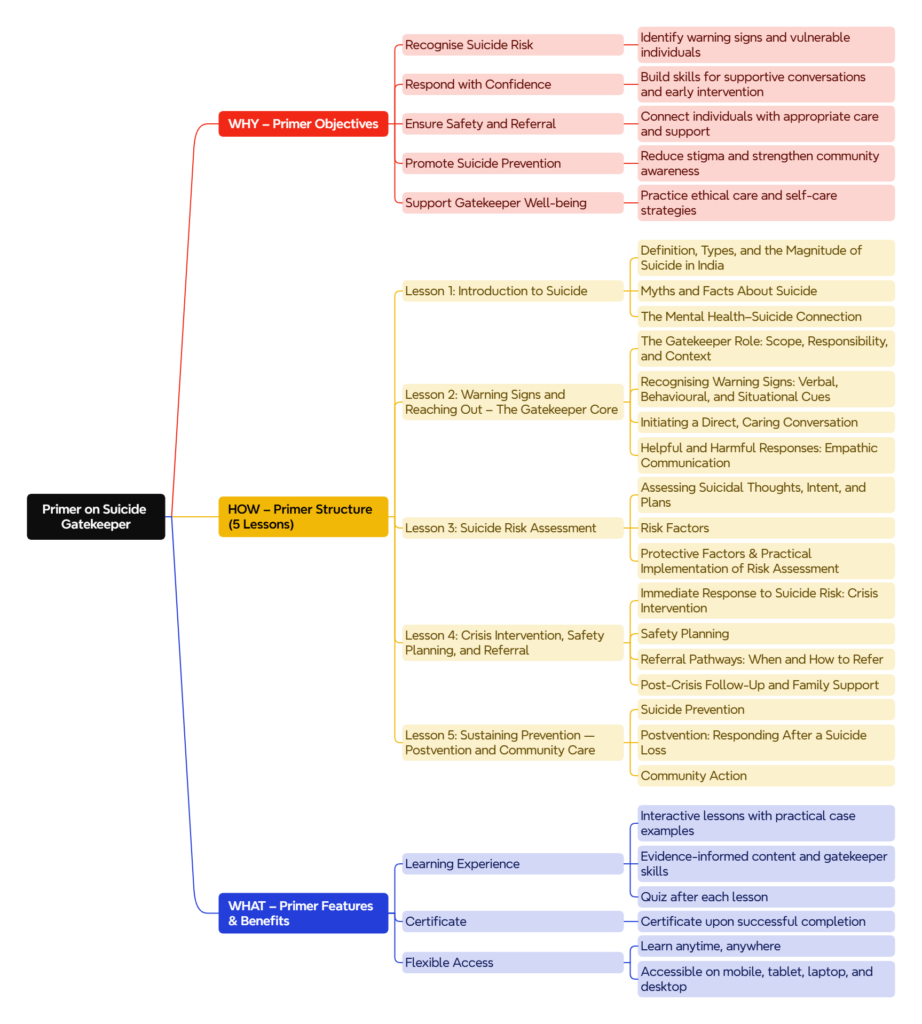
This primer builds the knowledge, communication skills, and practical readiness of frontline healthcare workers to act effectively as suicide gatekeepers — recognising distress early, responding with confidence, and connecting individuals in crisis to appropriate care.
On completing this primer, learners will be able to:
- Describe the magnitude and patterns of suicide in India using current national data, including state-level and demographic variation
- Identify biological, psychological, social, and situational risk factors associated with suicide
- Recognise verbal, behavioural, and situational warning signs of suicide risk across age groups and community contexts
- Initiate a direct, non-judgmental, and empathetic conversation about suicidal ideation
- Conduct a basic structured suicide risk assessment and categorise risk as low, moderate, or high
- Provide immediate psychosocial support and ensure safety during a crisis
- Identify appropriate referral pathways and facilitate timely linkage to care
- Describe evidence-based actions to support suicide attempt survivors and their families
- Challenge common myths about suicide using evidence-based facts, with sensitivity to Indian cultural and religious contexts
Instructional Design
Please read the following notes carefully to ensure you have dedicated time before enrolling in this module.
| Certificate Module | Primer on Suicide Prevention: A Gatekeeper Training Approach (GKT) |
| Learning Level | Builds competency across knowledge, skills, and attitudes: learners will acquire foundational knowledge of suicide risk and prevention, develop practical skills in risk assessment, crisis communication, and safety planning, and cultivate the attitudes and confidence needed to engage sensitively with individuals in distress — without requiring prior specialisation in psychiatry or mental health. |
| Learning Modality | Self-paced online asynchronous learning via the NIMHANS e-Learning platform. One needs to complete each lesson and topic and successfully pass the quiz (>80%) to go to the next lesson. Estimated engagement: 2–3 hours per lesson, across 5 lessons. Access duration is 30 days from the date of enrollment. |
| Module Structure | 5 Lessons | 17 Topics | 5 Quizzes with short essay* | 1 Pre-module Survey | 1 Post-module Feedback || 8 hrs Lesson 1: Introduction to Suicide (3 Topics) Lesson 2: Warning Signs and Reaching Out — The Gatekeeper Core (4 Topics ) Lesson 3: Suicide Risk Assessment (3 Topics) Lesson 4: Crisis Intervention, Safety Planning, and Referral (4 Topics) Lesson 5: Sustaining Prevention — Postvention and Community Care (3 Topics) |
| Pedagogical Approach | Evidence and Awareness – Introduces key concepts related to Primer on Suicide Prevention Gatekeeper Training (GKT), supported by brief research insights and case examples. Reflection – Encourages self-reflection through short exercises and scenarios to build understanding, reduce stigma, and increase awareness in working with individuals experiencing Suicide Prevention Gatekeeper Training. Practice – Focuses on developing practical gatekeeper skills such as recognizing suicide warning signs, assessing immediate risk, engaging in supportive conversations, ensuring safety, making timely referrals, and following up with individuals at risk within community and healthcare settings. |
| Design | Upon completing all lesson quizzes with a score of ≥80%, participants can download an e-Certificate of Achievement that displays their score. Three attempts are allowed for each quiz. Quizzes assess applied understanding through scenario-based and reflective questions, rather than rote recall. |
| Duration of Access | 30 days from the date of enrolment. |
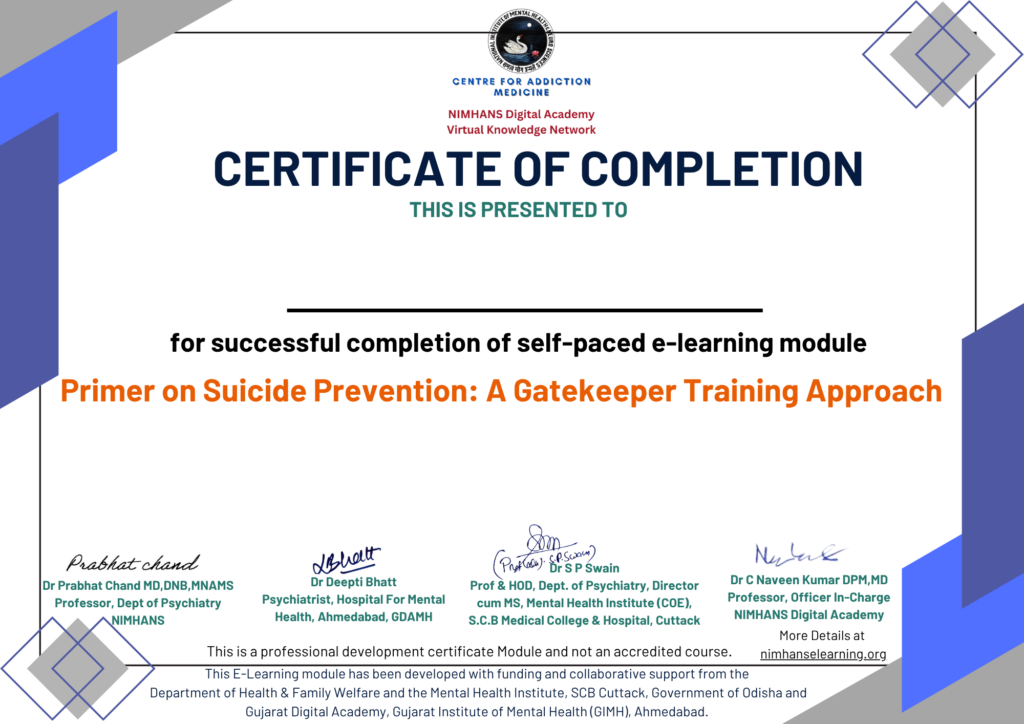
| Professional Development Certificate | Upon completion of all lesson quizzes with a score of ≥80%, participants can download an e-Certificate of Achievement displaying their score. Three attempts are allowed for each quiz. Quizzes assess applied understanding through scenario-based and reflective questions, rather than rote recall. |
| Suggested Citation | NIMHANS eLearning, Centre for Addiction Medicine & Virtual Knowledge Network, NIMHANS, Bengaluru, India. 🛡️ Primer on Suicide Prevention: A Gatekeeper Training Approach Available from: https://addictioncare.in/courses/primer-on-suicide-prevention-gatekeeper-training/ |
| Copyright Information | This license requires that reusers give credit to the creator. It allows reusers to copy and distribute the material in any medium or format in unadapted form only, for non-commercial purposes only. https://addictioncare.in/courses/primer-on-suicide-prevention-gatekeeper-training/ © 2024 by Virtual Knowledge Network, Centre for Addiction Medicine & NIMHANS Digital Academy is licensed under CC BY-NC-SA 4.0     |
| First Edition | July 2026 |
| Funding and Support | A collaboration between NIMHANS and Mental Health Institute, Odisha Digital Academy for Mental Health, SCB Medical College Cuttack, Dept of Health and Family Welfare, Govt of Odisha and Gujarat Digital Academy, Gujarat Institute of Mental Health (GIMH), Ahmedabad. |
| Connect with us | vkn@vknnimhans.in It will take 48 hours to respond to the relevant queries related to technical issues. |
| FAQS | 1. Is this an accredited course? This is a professional development certification module from the Centre for Addiction Medicine & NIMHANS Digital Academy and is NOT a formally accredited academic course. This e-learning module is recognised as a professional development module by the NIMHANS Board of Studies, 15th and 17th from CAM. 2. How do I get the Certificate of Completion? Complete all lesson quizzes with a score of ≥80%. Three attempts are available for each quiz. Download the e-Certificate of Achievement after successfully completing all requirements. 3. Do I need to complete lessons in order? Yes, you need to complete each topics in lesson and clear its quiz to move on to the next lesson. |
| Team (Planning, developer, Designer, Faculty, Technical support, Reviewers) Advisors: LINK | Centre for Addiction Medicine, Virtual Knowledge Network and NIMHANS Digital Academy National Institute of Mental Health and Neurosciences (NIMHANS), Bangalore, India Gujarat Digital Academy for Mental Health, GIMH, Ahmedabad Odishs Digital Academy for Mental Health, MHI Cuttack, SCB KNOW OUR TEAM |
Generative AI tools were used in the preparation of this content. All materials have been reviewed and validated by subject matter experts before inclusion.
Certificate for Complete Module
👋 Hi! Need help with NIMHANS eLearning?
You can chat with our AI assistant on WhatsApp for information and guidance.
📵 Please do not call this number.

The course was helpful, evoking and insightful.
You must log in and have started this module to submit a review.